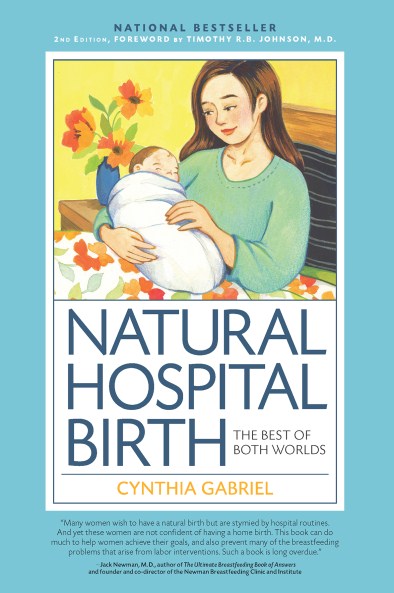
Natural hospital birth : the best of both worlds
verything goes in cycles in medicine and in health care,
just as in life. Cynthia Gabriel’s new book comes at a fortuitous
“sweet spot,†when obstetric birth practices in the United
States are again changing. As I write this, the American College
of Obstetricians and Gynecologists is liberalizing its statement on
vaginal birth after cesarean delivery (VBAC) with the hope of expanding
the use of VBAC, especially in smaller and rural hospitals, where it
has been largely abandoned.
With fathers now in attendance in operating rooms and extended
families at vaginal births, and with increasing choices for pain relief and
support persons, Natural Hospital Birth will allow for improved collaboration
and negotiation around these choices. It will be very useful not only
to birthing women but also to physicians, nurse-midwives, nurses, health
policy makers, and hospital administrators. The twenty-first century is a
time for collaboration: Midwives, family physicians, obstetric anesthesiologists,
labor nurses, obstetrician-gynecologists, and often high-risk
obstetricians and neonatologists are collaborating in a much more constructive
way than ever before, but they are doing so in an increasingly
medicalized environment. This is the environment where Cynthia
Gabriel focuses the lens for her book.