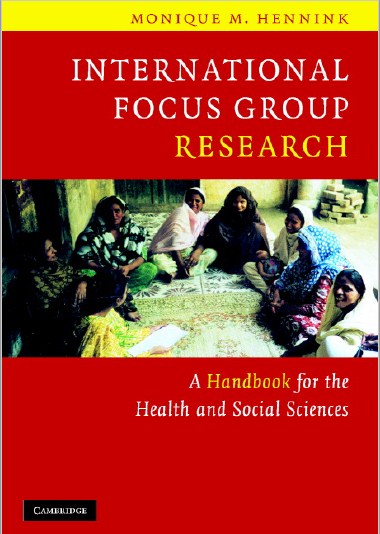
International Focus Group Research ; A Handbook for the Health and Social Sciences
There exist a large number of books on conducting focus group discussions,
however, most texts have an implicit assumption that the focus group
research will be conducted in western settings. These texts provide little
guidance for those embarking on focus group research in developing countries.
While many of the principles of focus group research remain the same
despite the context, the practical application will often differ. Existing texts
provide no guidance on conducting focus groups in another language,
developing a culturally appropriate discussion guide, translation issues,
training a field team, seeking research permissions, using tape-recorders in
culturally conservative settings and a range of other practical issues. As a
result novice users of the method remain uncertain of how to apply the
principles of focus group research to developing country settings.
Unfortunately, this uncertainty often leads to the absence of rigorous science
with inevitably poor quality outcomes.
There exists a great deal of experiential knowledge amongst those who have
conducted international focus group research, there are accepted procedures
and common strategies that we use for applying themethod and for managing
difficult situations, but little of this knowledge is published to assist those
embarking on focus group research in developing countries for the first time.
Therefore, this book is written in response to frequent requests from researchers
and research students for advice on how to conduct focus group discussions,
particularly in developing country contexts, and to respond to the
common concern ‘Am I doing it right?’ The intention of this book is to
document the procedures, practices and challenges in applying the method
to various research contexts. Following on from this, a second aim of the book
is to encourage greater transparency in the conduct of focus group research.
Often the application of focus group research is only superficially reported in
research documents, so there is little indication of how themethod was applied
in practice. It is hoped that this book will assist researchers to report the use
of the method and the decisions made during fieldwork with more confidence
if there is a documented guide to good practice in international fieldwork.