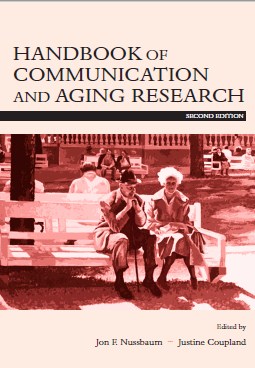
HANDBOOK OF COMMUNICATION AND AGING RESEARCH Second Edition
In the first edition of the Handbook of Communication and Aging Research, we wrote that a
simultaneous growth in the discipline of communication and in the population of older
individuals across the world has produced an explosion of research investigating various
aspects of communication and aging. This has taken place against a backdrop of traditional
gerontology, which has for the most part been heavily influenced by theories in
mainstream biology, psychology, sociology, and medicine, and has focused on the demography,
personality, use of social services, uptake of and satisfaction with health care,
and intergenerational attitudes. The field of social gerontology is relatively new, innovative,
and prolific, but still not well organized. Perhaps because of this, the centrality of
communication in the studies of aging is not yet well established. Yet, communication
and aging is at the forefront of the new wave of gerontology, giving priority to aging
as one of the range of issues currently being scrutinized by the social sciences. Since
the publication of the first handbook nearly 10 years ago, the study of aging by social
gerontologists has become more focused, more theoretically diverse, and more methodologically
interesting. This second edition of the Handbook of Communication and Aging
Research is our attempt to capture this ever-changing and expanding domain of research.
Five new chapters have been added, numerous chapters have received major revision,
and two classic chapters appear with only slight modification.